Heading to Manchester for The Royal Northern College of Music International Brass Band Festival, is another first for me. The event did not disappoint however and my only wish is I had caught more than the snippet I did. With exciting music both old and new being displayed by bands of the highest calibre the event was one that continued to push musical boundaries and raise these bands to the respected position they should hold in all musical circles.
The three day event this year from the 23rd to 25th of February showcased 11 bands alongside 12 renowned soloists. Of this huge selection I was able to attend the set on Saturday by The Tredegar Town Band and Black Dyke Band. I have to admit that this was a choice mainly made by my own cherry picking of soprano classic "The Land of the Long White Cloud" by Philip Sparke along with the wish to show a visiting American friend new to brass bands la crème de la crème in Black Dyke. Many of the sets at this year's event were penned by Sparke with the festival as a whole celebrating his repertoire and marking his 75th birthday year.
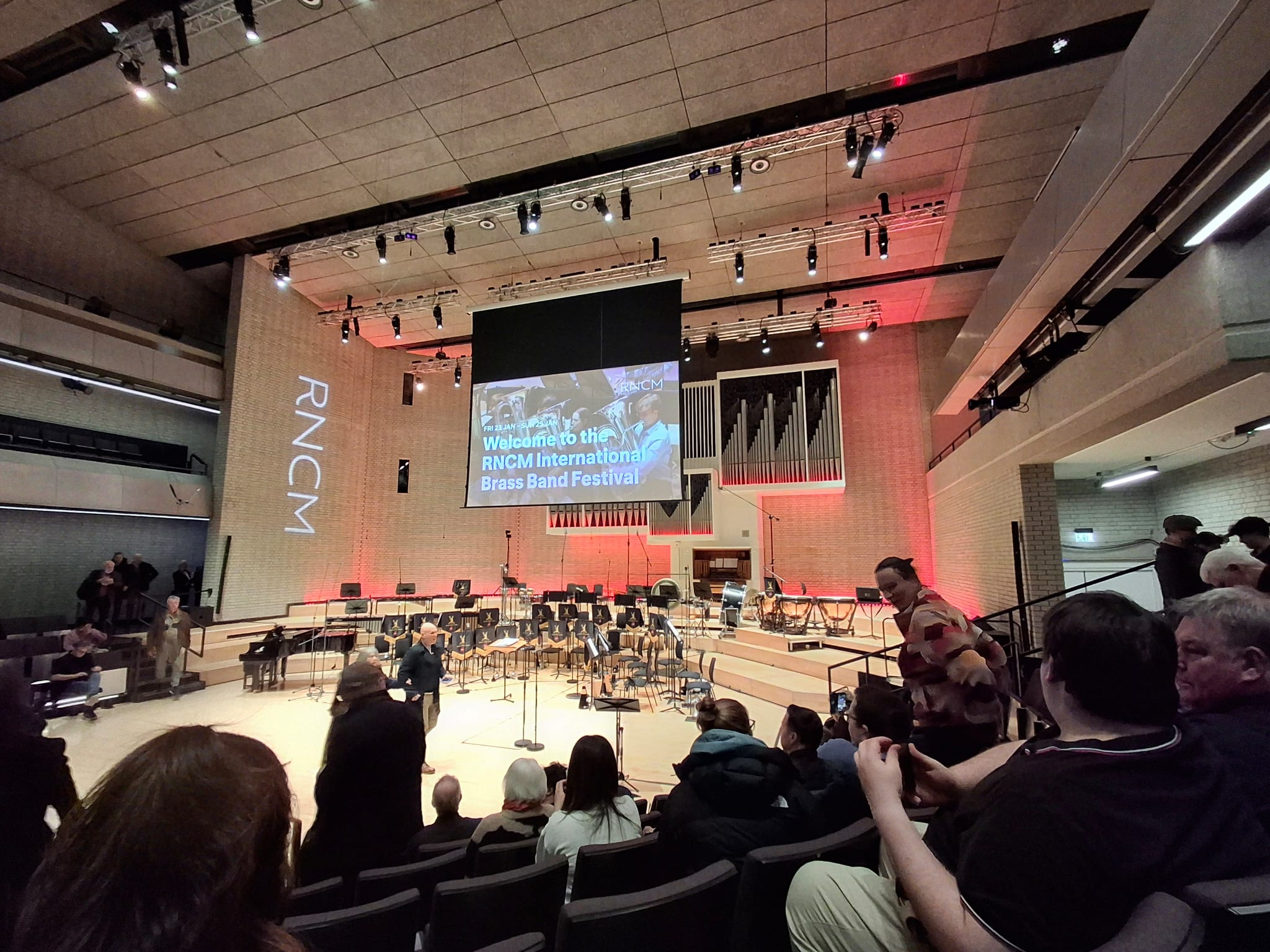
RNCM Concert Hall.
Entering the RNCM building it became immediately clear this was an international event with multiple languages overheard even before entering the café doors. Once inside the main space it was also very clear how well subscribed the concert was to be along with how diverse in age the audience was. This was undoubtedly in part due to the excellent student and under 26 discount coupled with the many local students of the college in attendance. The large student attendance became extremely clear when players studying at The RNCM from both Tredegar and even more so Black Dyke received huge cheers from a large group section in the audience. It is to be commendable that the festival organisers are able to offer such rates to young people especially when there was an additional 20% reduction for attendance of three events or more. It is clear that these techniques work and I hope any other events will focus more on their target demographics in future events.
Both events were staged inside of the RNCM Concert Hall, which is the larger of the two spaces within the complex, seating ~700. It is no wonder therefore that the bar was crowded and that nearly every seat was occupied. Within the audience there was a clear academic skew with many well known banding faces in attendance from notable members from other bands not performing at the event to conductors, composers. What was refreshing was that this group was also supplemented with members of the public when bands with household names were playing. Speaking to one woman next to me, who did not play an instrument nor recognise the name Tredegar said she attended every year to see Black Dyke. This speaks volumes about the music selected that it can both cater to clientele who require world premieres, boundary pushing commissions and virtuosic solos as well as attracting those who wish to only attend a single concert by their favourite band. As someone closer to the single concert group I awaited Tredegar's set with anticipation for some interesting though perhaps abstract works. And while they did deliver a performance with plenty academic rigour the content and accompanying descriptions before each piece allowed for an informed enjoyment of their works.
Conductor: Ian Porthouse
Tamsin Crook – A Spark Forgotten
Derek Bourgeois – Euphonium Concerto
Soloist: Glenn Van Looy
Phil Lawrence – Melisande (World Premiere)
Philip Sparke – Land of the Long White Cloud
Opening the set was a very recent commission "A Spark Forgotten" (2025) composed by Tamsin Crook a cornet and arranger from Cumbria. The piece bursts with a building mysterious energy and has great moments for percussion which shine in a very barren band supporting them. And what a percussion collection it was a group of seven in all black sit at the back though for this piece only four are involved. This gave me a slight Chekhov's percussionist feeling though the payoff would have to wait for another two pieces time. The band built to a driving finish and huge applause which was also offered to Tamsin who was in attendance.
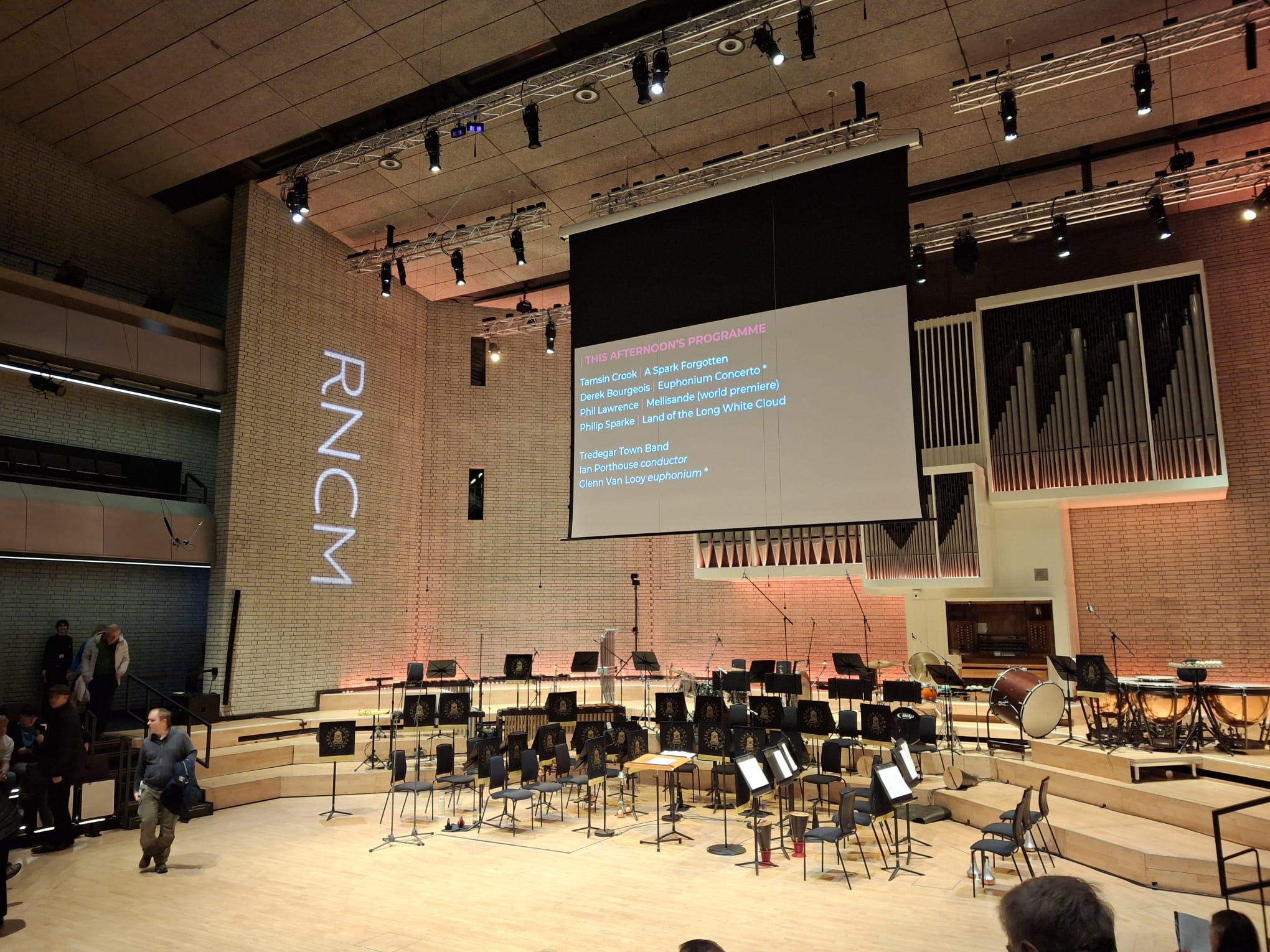
RNCM Concert Hall.
Proceeding onwards a stunning performance of the "Derek Bourgeois Euphonium Concerto" (1990) was given by guest soloist Glenn Van Looy. This concerto is one that both parties know well having previously collaborated on it for Glenn's 2019 release "Step Out" on the Chandos label. Knowing they had climbed this mountain before I think played a key role in the relaxed and confident performance produced by both the band and soloist. With huge extremes taken in both frequency and dynamic range Glenn took time to savour the apexes of lyrical passages and hold tight to near perfect intonation across at least four octaves. The accompanying band also pushed their own limits with whisper like muted sections from their five basses and cheeky smiles shared between soloist Glenn and soprano cornet Rob Westacott as they chased ever higher in call and response. Though in the second movement devilishly high, fast, solo sections did lead some players to trip and set off others like dominoes, the overall performance was one which rightfully impressed all present.
I was most pleasantly surprised by Melisande by Phil Lawrence which proved to my favourite piece of the day. The topic of the piece focuses on the composer's own dog, Mélisande, and her short life. In a description of the work Lawrence writes that the piece is a "heartfelt tribute to her life, celebrating her as an irreplaceable and cherished member of our family". The work follows her from birth, playful years as a puppy and the role she played as a dedicated mother. While describing the section in which Mélisande chases a butterfly, Ian Porthouse took a moment to point out the butterfly, portrayed by principal cornet, Dewi Griffiths, who did indeed later flit and float very well. The work was also chosen in memory of Phil Lawrence who sadly passed after a short battle with cancer in June 2025 and whose family were in attendance at this world premiere.
The piece itself was a delight. The required seven Chekhov's percussionists were awakened and were instantly sent into action as the piece and birth of Mélisande began in "The spark of birth". Starting with the first of many wonderfully weird percussion instructions a lonely octave is played on "Vibraphone upper 8va bowed, lower 8vb with stick" which hangs waiting for life to begin in the form of the cornets giving the first indication of the cheeky dog about to join us. The repeated percussion followed by cheeky moving cornet lines accelerates and gives the feeling of an engine crank slowly catching more and more building up a heartbeat which becomes the ever changing excited beginning of her puppy years.
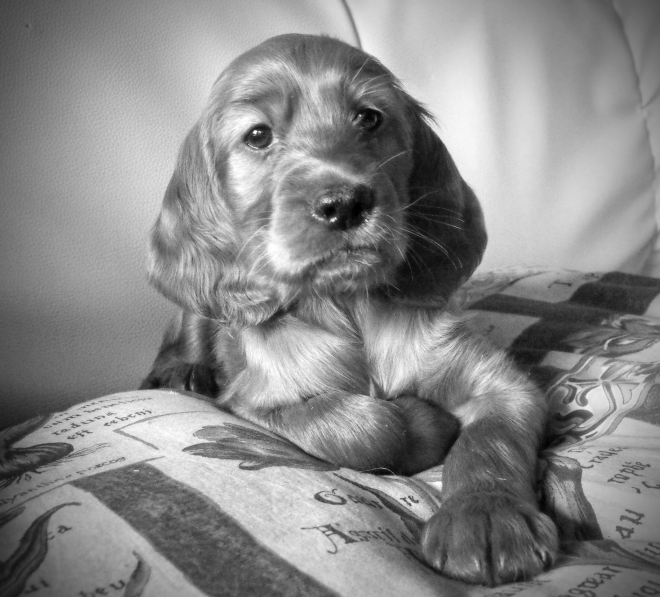
Mélisande photo taken from Obrasso.com.
The percussion within the puppy years is a wonder to watch with them not given a second's rest as new sounds appear and disappear and Mélisande discovers the world. The score turns into an essay of descriptors such as "football rattlecrank fast", "whip", "tambourine on snare drum skin" and "metal beater scrape from centre of suspended cymbal out to edge very quickly" which nail the depiction of a life filled with novelty at each step. So too in the cornet section Lawrence includes instructions for changes of mutes along with markings for "fltz", "HOB" and "upper note player does Wah" so the cornets aren't left to dawdle. Eventually the percussive chaos settles into everyday life and the personality of the Irish Red Setter shines through as she goes on adventures with a friendly tortoise, fish and a squirrel. Eventually Mélisande becomes a mother and gorgeous bell tree motifs are added replicating, in my mind, the sound of the descending diatonic major scales of church bells. This is followed by a rousing conclusion which had a feel of a triumphant film score. The performance itself was a joy with a playful, light quality that acted as a palate cleanser in the set as well as showcasing the great percussion team in this expanded band.
To finish I was treated to "Land of the Long White Cloud" by Philip Sparke. Though I knew this had the gorgeous soprano cornet line I had purposefully kept myself from hearing it before the event in the hope of enjoying each section live for the first time. The shock of the triumphant full band opening was therefore a complete but welcome surprise. The hymn-like quality of the melody carried by horns down to lower brass was carried wonderfully by Tredegar and the tune reminded me strangely of a hymn from my childhood Do not be afraid, for I have redeemed you though I am certain there is no connection given the depiction of New Zealand this piece produces.
This piece was originally penned as the set work for the New Zealand Brass Band Association National Championships (1979) and was Sparke's first arrangement for competition. It is therefore no wonder that every member of the band is worked so hard, none more so than Rob Westacott on soprano who rose to the occasion. With extraordinary stabs from on high, he punctuated against the rest of the band into the short driving march-like section. Truly the man of the match even before reaching the soprano solo making massive impact on the shape of the work. Passing quickly through 2/4 to 6/8 melody in the lower brass that reminds me a bustling city with muted cornet car horns we reach a sudden silence that marks the sparse apex and the entrance of a haunting soprano melody which was handled with ease. This powerful return to the soprano motif in lower brass with accompanying fanfare is rousing before one final drop to an excellent pianissimo standstill and an accelerating dash back through the previous themes towards an immense finish and deserved applause.
After a break for dinner at Bundobust, (All veggie Indian tapas well worth a go!), I returned to enjoy a second set by The Black Dyke Band.
Conductor: Professor Nicholas Childs
Paul Lovatt-Cooper – Fanfare for Bradford
Bruce Broughton – Wildfire (World Premiere)
Philip Sparke – Gemini
Soloists: Tom Hutchinson – cornet, Adam Bokaris – euphonium
(World Premiere for Brass Band)
Edward Gregson – Symphony in Two Movements
~Interval~
Simon Dobson – Percussion Concerto
Soloist: Yasuaki Fukuhara – percussion
(World Premiere)
Ottorino Respighi, arr. Howard Snell – Feste Romane
Or at least most of a set... Sadly given my need to not sleep on the streets and Northern Rail's lack of services I was only able to enjoy the first half before treating myself to a rail replacement bus back to Lancaster. Still any opportunity to enjoy Black Dyke is a great treat and this occasion proved no different.
This particular concert was billed to be the high point of the festival with the occasion being recorded for use on BBC Radio 3 and can be listened to here. This excellent opportunity for raising the profile of banding to the wider classical audiences was not missed by the players of Black Dyke as well as the audience. This lead to both an excellent performance and some of the loudest cheers heard in the day as everyone from the community wished success upon the venture.
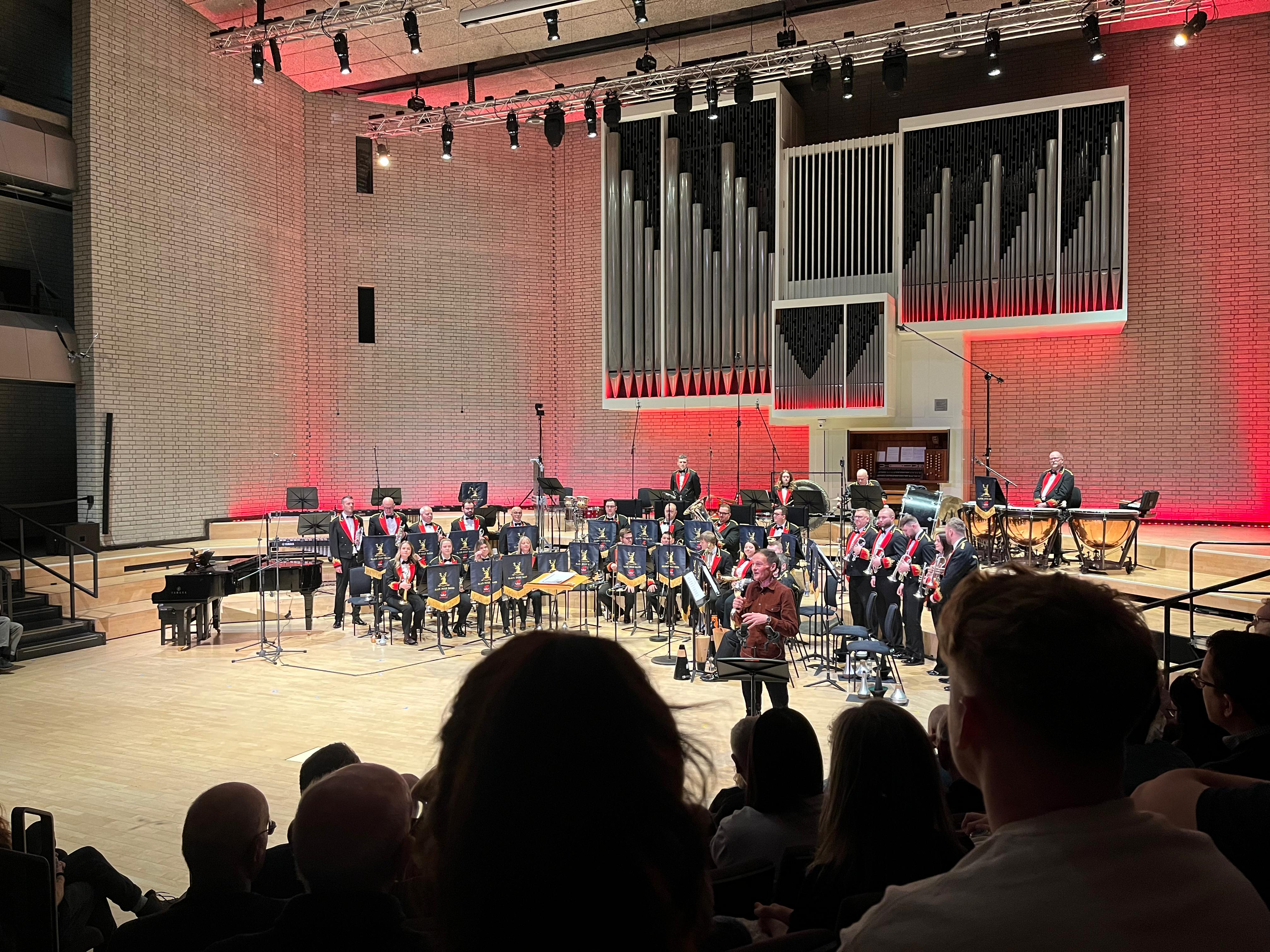
Black Dyke being introduced for BBC Radio 3.
Proceedings were opened with "Fanfare for Bradford" written by Paul Lovatt-Cooper which lifted the energy even higher following the huge cheers for Professor Nicholas Childs. Following the short fanfare an interesting interview was conducted with Bruce Broughton composer of Wildfire. While all the content within the interview was excellent, because of the length of time it continued for the energy within the hall began to wane. Indeed even some of the players on stage began to let their smiles fade as they waited to be unleashed upon Wildfire.
The interview focused on the structure of the piece and how it depicts the terrifying 2025 Los Angeles fires. This is a topic I was aware of through the news and the videos shared by renowned trumpeter, Jens Lindemann, who himself fundraised after losing his home in the Pacific Palisades fires. At the time of these events, Broughton himself began writing but eventually was forced to leave his home as the flames approached, unsure if he would return. This power of the fire was the inspiration for the first section of the piece and it was reflected clearly in the work with the band working hard throughout on endless runs depicting the expansion. Broughton also discussed that he did not want a triumphant finish to the piece due to the horrid nature of the event but instead turning to the bravery of the firefighters for inspiration to close.
"Gemini" proved an entertaining and charismatic piece with both soloists Tom Hutchinson and Adam Bokaris giving a relaxed performance despite the extreme requirements of the work. Some passages from Bokaris were difficult to hear clearly which I initially put down to his further distance. Perhaps it is however more likely to be a consequence of the change in tonal colour when the piece was restructured for brass band from the original wind arrangement. In the quieter sections and breaks the techniques of both soloists shine through clearly highlighting the abilities and tonal colour of both instruments. This new premiere of the work rewritten also acted as a test of Hutchinson after his recent move to Black Dyke. He clearly rose to the occasion with the incredibly fast joint lines which slotted perfectly in tone alongside the already settled Bokaris.
To finish my abridged version of the concert, I was treated to Edward Gregson's "Symphony in Two Movements" (2012) which has had a huge outing in 2025 as the set work for the National Brass Band Championships of Great Britain. I was lucky enough to attend this year's national final in The Royal Albert Hall and therefore was excited to see if the 2nd place recital would be repeated as previously in London. Comparing my notes between the two performances I felt that the tempos had been adjusted relative to the original listening. This was especially clear in the much faster opening and later at bar 357 when the ringing tam tam marked "LUNGA" seemed decidedly corta. I am not here to give any advice or instruction however and only want to say that I missed the hanging silence following the tam tam. Though perhaps this is just a less contest-centered performance without the need to overaccentuate for adjudicators. The ending was just as excellent as the first time I heard it performed with the mixture of tubular bells ringing out and trombones giving a rousing hunting horn fanfare to herald the conclusion. After hearing the iconic tutti band accented tenuto crotchets both the set and my day trip to Manchester were at an end.
The day trip and review would not be complete however without one last look at another brassy icon from the north... Divina De Campo.
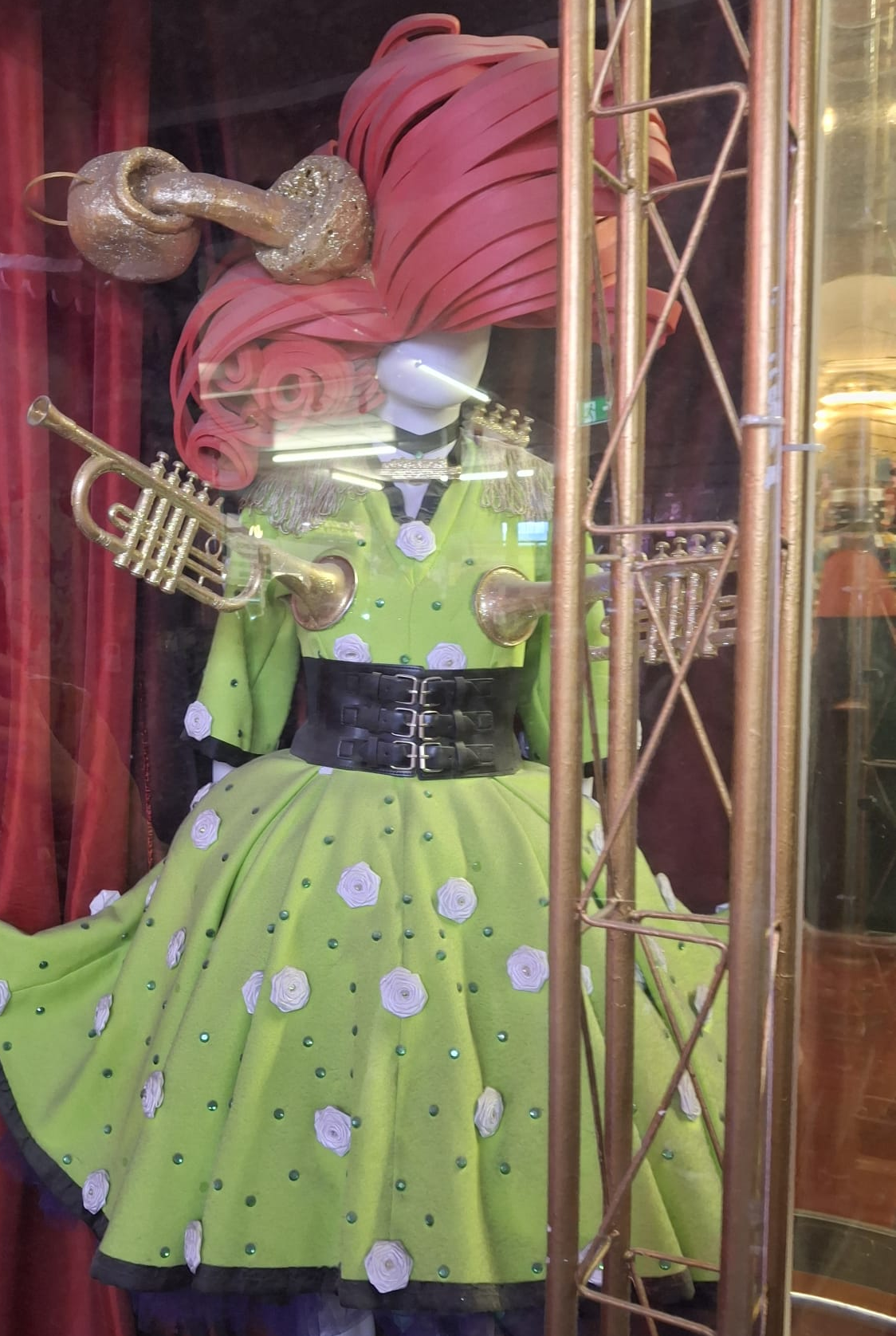
Outfit worn in the "queen of your hometown" challenge, episode 1, series 1 of RuPaul's Drag Race UK.
With outfits nearly as iconic as the purple uniforms, it's not hard to guess why she is billed as the second best thing to come out of Brighouse. I stumbled across this one used in RuPaul's Drag Race season 1 while in Afflecks in the Northern Quarter. I highly recommend giving it a watch especially since drag and brass band contesting are two of the only competitive artforms in the world! Perhaps there is more to be learned than has already been gained at events such as Kinky Toots... New uniform anyone?